
If you run a business in Saudi Arabia, you have probably heard both terms — SEO and local SEO — used as if they were the same thing. They are related, but they are not interchangeable, and paying for the wrong one first is a common way to spend money without seeing customers.
Here is the short answer. SEO (search engine optimisation) is about ranking your website in Google’s regular search results, for people anywhere. Local SEO is about showing up when people nearby search for what you do — in Google Maps, in the map pack of three businesses at the top of local results, and in “near me” searches. Most Saudi clinics, cafés, salons, shops and service businesses need local SEO first, because their customers live within driving distance. This guide explains the difference properly, so you can decide for your own business.
The one difference that explains everything else
Regular SEO answers the question: “Which website best answers this search?” Local SEO answers a different question: “Which nearby business should this person call, visit or message right now?”
That single difference changes what Google looks at. For a normal search, Google weighs your website’s content, structure and reputation across the web. For a local search, Google weighs those things too — but distance, your Google Business Profile, your reviews and the consistency of your business information across the internet matter just as much, sometimes more.
A business can have a beautiful website and still be invisible on Maps. Another can have a modest website and win customers every day because its profile, reviews and listings are in order. Understanding local SEO vs SEO means knowing which race you are actually running.
Where the results appear
Regular SEO results are the familiar blue links — ten or so website pages listed down the search page. They suit searches like “how to choose a water filter” or “best accounting software”, where the searcher could be anywhere and a website page is the right answer.
Local results appear in two places. First, the map pack: a map with (usually) three businesses pinned and listed above or among the blue links, each with its rating, reviews, hours, phone number and directions button. Second, Google Maps itself, where many Saudi customers now start their search directly — typing “dental clinic” or “عيادة أسنان” and choosing from the pins around them.
For a search with local intent, the map pack gets the attention and the calls. A first-place blue link below it can receive less business than the third business inside the pack. That is why the distinction matters in money, not just in terminology.
What each one actually works on
What regular SEO works on
- Your website’s pages — clear, useful content that answers real searches, organised so Google can understand what each page is about.
- Technical health — fast loading, working correctly on phones, secure (HTTPS), no broken pages or dead ends.
- Keywords and intent — matching each page to the searches it should win, without several pages competing for the same search.
- Links and reputation — other trustworthy websites referring to yours, which Google reads as votes of confidence.
- Time — rankings for competitive website searches are usually built over months of steady work.
What local SEO works on
- Your Google Business Profile — claimed, verified, correctly categorised, with true hours, real photos, a complete services list and a description in Arabic and English.
- Reviews — a steady flow of genuine reviews, and a calm, professional reply to every one of them.
- Citations — your business name, address and phone number listed identically on directories and platforms, so Google is confident all of them are one real business.
- Your location pages — website pages that accurately serve the cities and districts you cover, written for those customers rather than copied between cities.
- Proximity signals you cannot fake — where your business physically is, and whether your information everywhere agrees about it.
Notice the overlap: a healthy, fast, well-organised website helps both. But a business that only does website work and never touches its profile, reviews or citations has done, at most, half of local SEO. The full picture is what our services are built around — profile, maps, reviews, citations and the website, in that order for most local businesses.
A side-by-side comparison
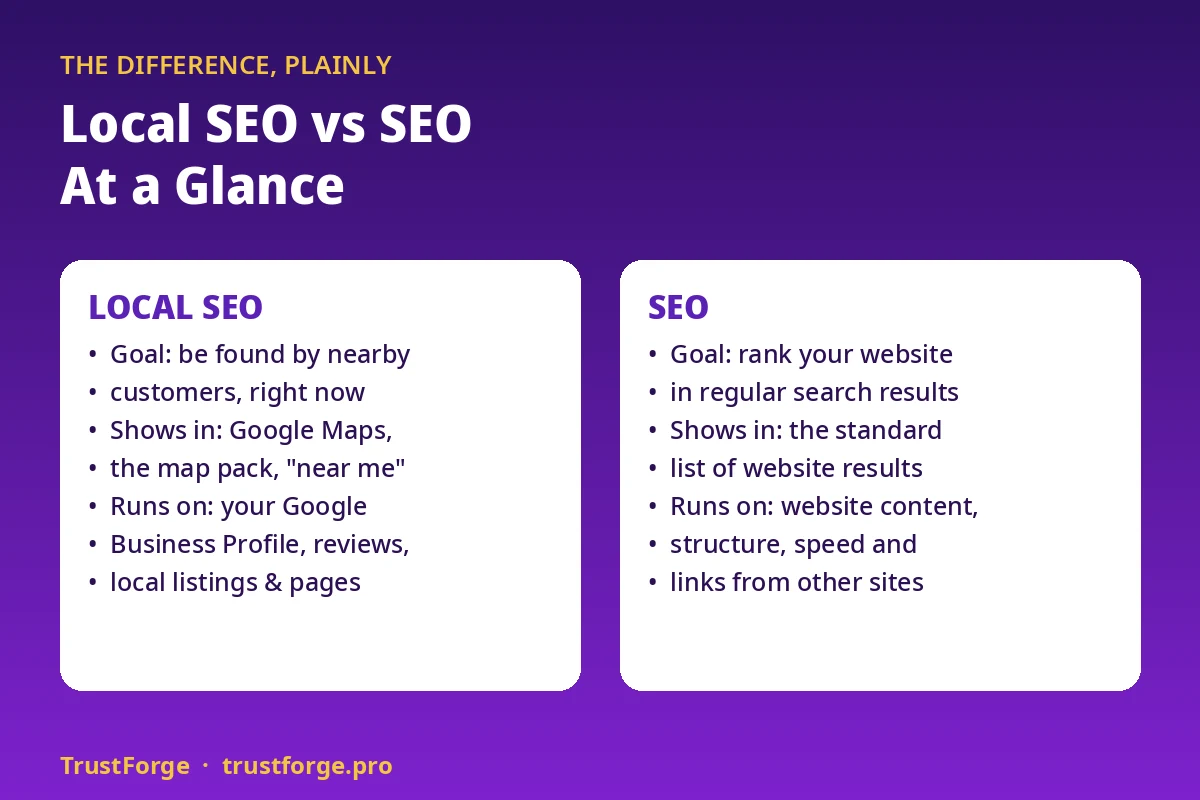
| Question | SEO | Local SEO |
|---|---|---|
| Main goal | Rank website pages in regular results | Appear in Maps and the map pack for nearby searches |
| Who it reaches | Searchers anywhere | Customers within your real service area |
| Most important asset | Your website | Your Google Business Profile + your website |
| Reviews matter? | Indirectly | Directly — rating and review count influence local ranking and choice |
| Typical first result | Enquiries from content and service pages | Calls, directions requests and WhatsApp messages |
| Where it fails | Thin, copied or slow pages | Unclaimed profiles, wrong hours, inconsistent phone numbers |
Neither column is “better”. They answer different searches. The mistake is funding one while your customers are using the other.
Which one does your business need first?
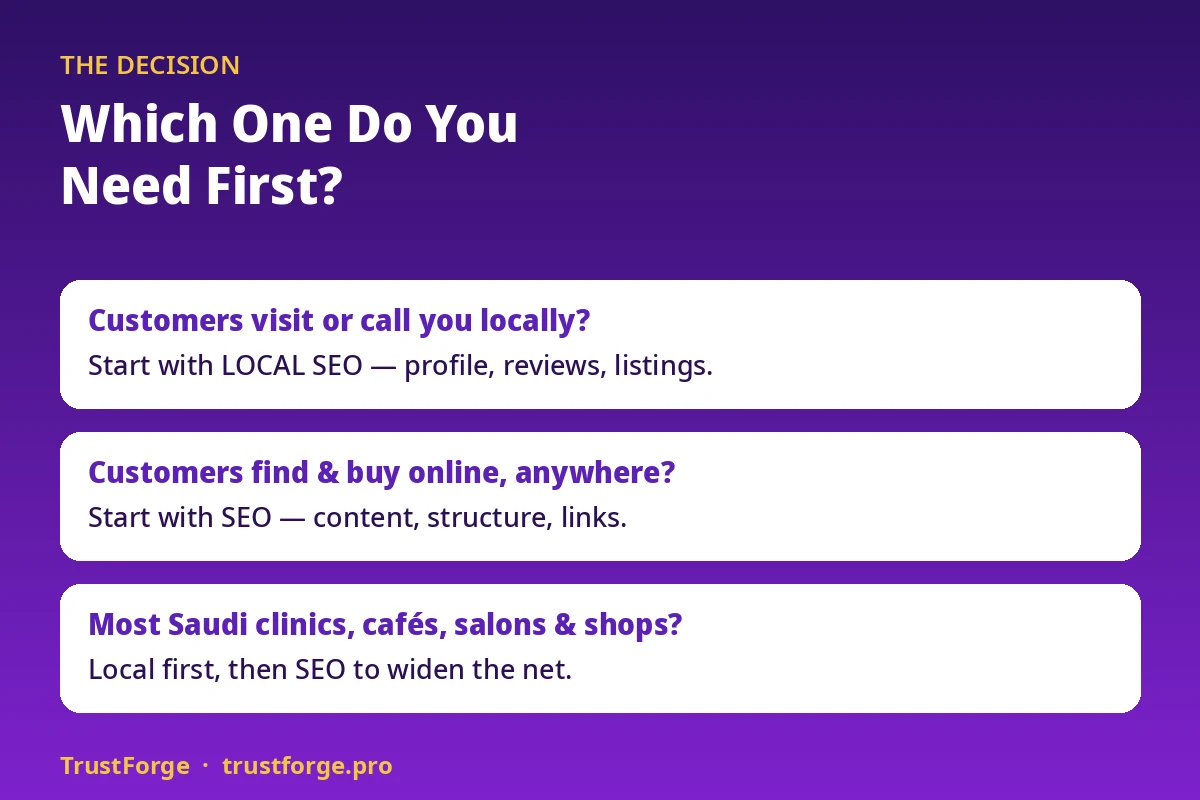
Start with local SEO if customers must physically reach you or you must reach them: clinics, dental and dermatology practices, cafés and restaurants, salons, gyms, car services, plumbers, cleaners, and any shop that lives on passing and nearby trade. Your buyers search with a place in mind — a district, a city, or simply “near me” — and they decide from the map, the rating and the photos, often without opening a single website.
Start with regular SEO if you sell across the whole Kingdom or beyond it: an online store shipping nationally, a software or training business, or a company whose customers research for weeks and compare detailed pages before enquiring. Your battleground is the blue links, and content depth wins it.
You need both, in sequence, if you are a local business with ambitions to be the known name in your city. Local SEO brings the calls that are available now; regular SEO builds the authority that makes your name the one people search for directly. In practice, for the Saudi businesses we speak to, the sensible order is: profile and reviews first, website health alongside, content depth after. That sequence is the thinking behind how TrustForge approaches local search as a whole.
Two examples
A dental clinic in Riyadh. Its customers search “dentist near me” or by district, compare ratings, and tap call or WhatsApp. Almost all of its opportunity sits in the map pack. Local SEO — profile, categories, services, photos, reviews — is the priority; a blog post about dentistry ranked nationally would bring readers, not patients.
An online retailer selling across Saudi Arabia. Its customers compare products from Jeddah to Dammam and buy without visiting anywhere. There is no map pack for most of its searches. Regular SEO — product and category pages, speed, content — is the priority; a Maps profile is a minor trust detail, not the engine.
Most real businesses sit between these two, which is exactly why the honest answer to “local SEO vs SEO” is “which searches bring you customers?” — not “which service sounds more complete?”
What they cost — in effort, not just money
Local SEO’s early wins are mostly labour, not budget: claiming the profile, correcting information, listing services, adding real photos, setting up a review habit. None of it requires advertising spend, and much of the foundation is one careful pass followed by steady upkeep.
Regular SEO asks for more patience and more production: pages written properly, technical fixes, and months of consistency before competitive rankings move. Businesses that expect website rankings in two weeks are usually disappointed; businesses that ignore their free Maps presence for those same months leave the faster channel untouched. Sequence matters more than size of budget.
Frequently asked questions
Is local SEO just a part of SEO, or a separate service?
It is a specialised branch of SEO that shares the same foundations — a healthy website, honest content — but adds the profile, reviews, citations and proximity work that regular website optimisation does not cover. Treating them as identical is how businesses end up with a polished website and an unclaimed Maps listing.
Can I do local SEO without a website?
You can start. A complete, well-kept Google Business Profile can win calls and directions on its own, and many small businesses begin there. A website still helps: it gives Google and customers more to trust, and it is where your services and locations can be explained properly. Profile first, website close behind, is a workable order.
How long does each take to show results?
Correcting and completing a profile can improve how your listing looks as soon as Google approves the changes, and local movement in less competitive searches can build over weeks. Competitive website rankings from regular SEO usually take months. Anyone guaranteeing a position by a date is guessing — be careful with promises in either discipline.
My competitor has a worse website but ranks above me on Maps. Why?
Because Maps ranking is not a website contest. Your competitor’s profile may be older, better categorised, more reviewed, or simply closer to the searcher. Local SEO exists precisely to close that kind of gap: profile strength, reviews and consistent information, not website decoration.
The short version
SEO ranks your website for searchers anywhere. Local SEO puts your business in front of nearby customers at the moment they are ready to call, visit or message. If your customers are within driving distance, local SEO is not the optional extra — it is the main channel, and your website work supports it. If your customers are everywhere, regular SEO leads and local plays a smaller part.
If you are not sure which searches your customers actually use to find a business like yours, that is the right place to start. Ask for a free local SEO audit: one page showing how your business appears on Maps and in search today, against the businesses winning your customers — and the fixes in the order we would do them. You can also reach us on WhatsApp at +966 57 8581 358.