
“How long does local SEO take?” is usually the second question a Saudi business owner asks — right after “what will it cost?” It deserves a straight answer, so here it is: the first fixes can be made in days, the first visible movement usually comes within weeks, and a strong position in a competitive area is normally the work of months, not days. Anyone who promises you the top of Google Maps by a specific date is selling you a date, not a result — Google does not work to anyone’s calendar.
This guide breaks the timeline into its real phases, so you can tell the difference between a business that is progressing normally and one that is paying for nothing. It also explains what genuinely speeds local SEO up, what slows it down, and how to judge progress honestly while you wait — because most of the damage in this industry is done in the waiting, when an owner either gives up too early or keeps paying long after the work has stopped.
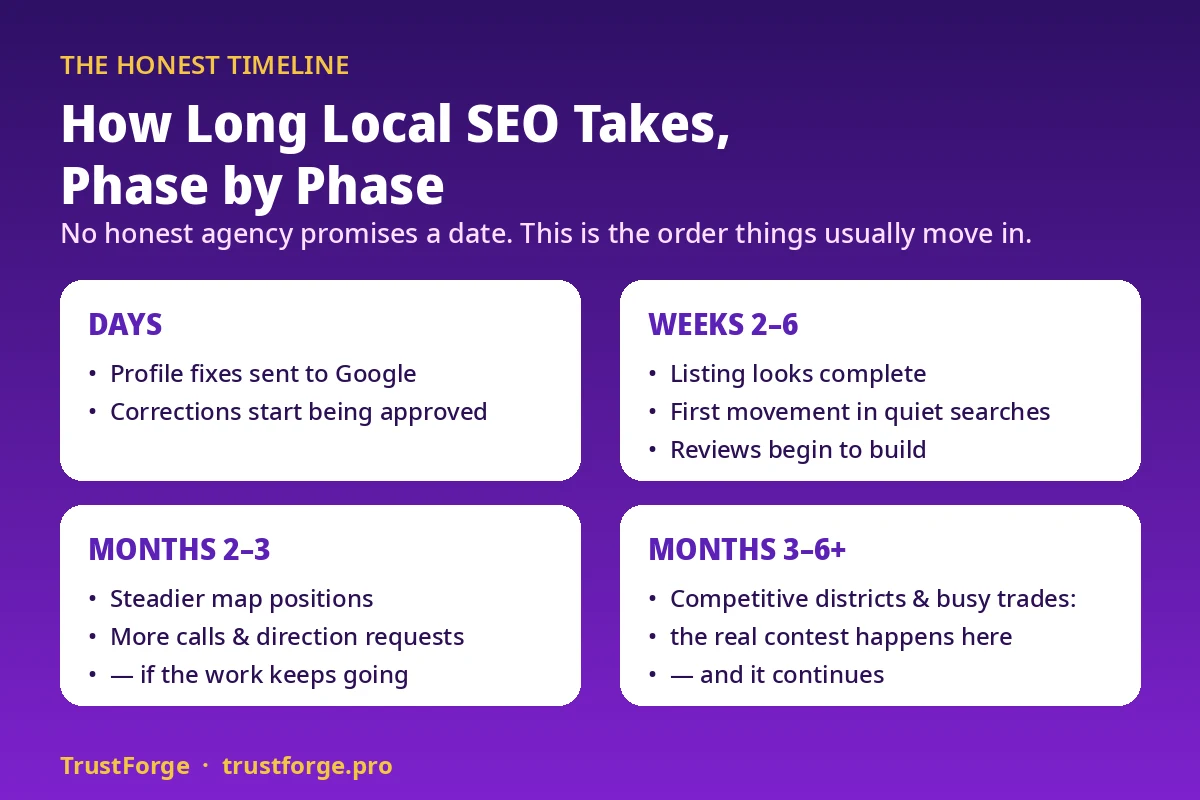
The short answer, phase by phase
Days — the foundation is fixed. Claiming or correcting your Google Business Profile, fixing your category, hours, phone number and pin, adding your real services and photos: this work itself takes days, not weeks. Some changes appear as soon as Google approves them; others sit in review for a while. At the end of this phase your listing looks right — but looking right is not the same as ranking higher yet. Nothing has had time to compound.
Weeks two to six — the listing starts to work. With a complete, accurate profile, you can begin appearing in more of the quieter searches — your business name plus a service, your district, less competitive combinations. Reviews you start collecting now begin to show. This is also when the first honest signal appears: not your position for one search on one phone, but whether more people are finding, calling and asking for directions than before.
Months two to three — positions steady. If the underlying work continues — reviews arriving steadily, details kept consistent everywhere, photos and information kept current — map positions in moderately competitive searches usually become steadier rather than flickering in and out. A clinic in a mid-size neighbourhood, a salon in a smaller city, a workshop in a trade with few serious rivals: this is often the window where the effort clearly starts paying for itself.
Months three to six and beyond — the competitive contest. In a busy Riyadh or Jeddah district, in trades where every serious competitor has hundreds of reviews and a well-kept profile, this is the realistic horizon — and local SEO never truly “finishes” there, because your competitors are not standing still either. Think of it less as a project with an end date and more as taking your place in a queue that reorders itself every day.
Why the range is so wide
Owners are often frustrated that one business “ranked in a month” while theirs is still climbing after four. The comparison is usually unfair, because four things differ between them.
Your starting point. A profile that was claimed years ago but left incomplete is much closer to results than one that was never claimed, is duplicated, or carries the wrong phone number across the internet. Fixing confusion takes longer than filling gaps.
Your competition, within a few streets. Local SEO is a neighbourhood contest, not a national one. You are not competing with every clinic in Saudi Arabia — you are competing with the ones a customer could realistically drive to. A sparse area forgives a modest profile; Olaya or a prime Jeddah district does not.
Your reviews — how many, and how steadily. Reviews influence both ranking and whether a customer chooses you once you appear. A business that earns a few genuine reviews every week builds a signal Google can trust. A business that suddenly acquires a pile of reviews in one weekend — however they were obtained — creates a pattern that looks like exactly what it is.
Whether the work actually continues. Local SEO’s early phase is a list of fixes. Its later phase is a rhythm: replying, updating, adding real photos, keeping every listing consistent when anything changes. Most slow timelines are not slow because Google is slow; they are slow because the work stopped in week two.
What makes it faster — and what makes it slower
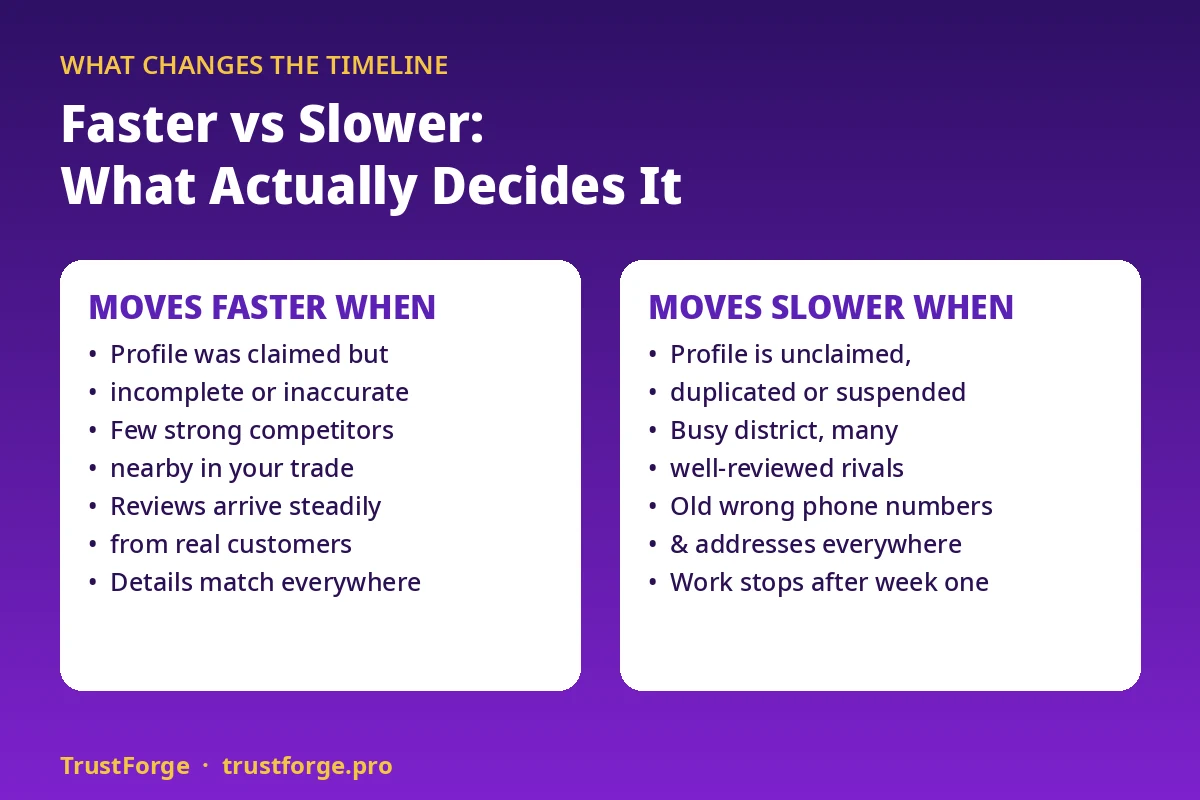
Timelines shorten when the basics were almost right: the profile existed, the business is real and easy to verify, the area is not crowded with strong rivals, and the owner answers reviews and keeps information true without being chased. They lengthen for reasons that are mostly unglamorous: an unclaimed or duplicated listing, a suspension to appeal, an old number still live on directories and social accounts, a name written three different ways, or a trade — dentists, dermatologists, car rental — where every competitor arrived years ago and never stopped.
One more honest point: nothing legitimate makes it instant. Paid ads can put your name at the top of the page today, and for some businesses that is the right bridge while local SEO builds — but ads are rent, not ranking; the day the spending stops, so does the position. Shortcuts sold as “secret ranking tricks” tend to end in suspended profiles, and a suspension costs more time than patience ever did.
How to judge progress while you wait
Because “wait months” is an easy sentence for a lazy provider to hide behind, you need measures that cannot be faked. These are the ones we would point any business owner to — and they are the same questions collected in our FAQs about how this work is reported.
- Actions, not adjectives. Every month you should be able to see what was actually done: which fields were corrected, which listings were fixed, which photos and posts were added. A report that only says “SEO is in progress” is not a report.
- Visibility in more searches. Not one heroic screenshot, but a widening set of searches — name, service, district — in which your business appears where it previously did not.
- Customer actions. Calls, direction requests and WhatsApp messages that start from your profile are the point of the exercise. They move before rankings look impressive, and they matter more.
- Reviews arriving steadily. A slow, genuine trickle from real customers, each one answered, is both a ranking signal and the thing future customers actually read.
Judge against your own starting point, not against the business across the road. The question is never “am I first yet?” but “am I visibly further than last month, and can I see the work that moved me?” That is the standard TrustForge holds its own reporting to: transparent, monthly, and tied to actions a business owner can verify.
A realistic promise — and the one to walk away from
A realistic provider will tell you what phase you are in, what has been done, what is expected to move next, and roughly when — in ranges, with the reasons attached. They will also tell you plainly if your area and trade make this a six-month contest rather than a six-week one, before you pay, not after.
Walk away from anyone who guarantees a position (“number one in 14 days”), who cannot show you the actual changes made to your own profile, or who suggests buying reviews to shorten the timeline. Each of those converts a slow-but-real asset into a fast, fragile one — and when it breaks, the months start again from zero.
Frequently asked questions
Can local SEO work in a week?
The fixes can be done in a week, and a corrected listing can start looking right as soon as Google approves the changes. Meaningful movement — steadier positions, more calls — is a matter of weeks at the earliest, and months in competitive areas. A week is enough to start properly; it is not enough to finish.
Why did my position jump up, then fall back?
Movement early on is often unstable: Google tests updated listings, your competitors change things too, and position also depends on where the searcher is standing when they search. Judge the trend over a month, in customer actions as well as positions — not a single day’s screenshot, yours or anyone else’s.
Does posting on my profile make it work faster?
Posts, fresh photos and answered questions keep a profile looking alive and give customers reasons to choose you, and keeping information current protects what you have built. They support the timeline; they do not replace the foundations — correct category, accurate details, consistent listings and genuine reviews.
When should I give up on a provider?
If after two to three months you cannot see what was done, your details are still wrong in places, no reviews are being earned, and reports contain promises instead of actions — the problem is not the timeline. The work itself is missing, and more waiting will not fix that.
Wondering which phase your business is actually in? Ask for a free SEO audit — we will check your profile, your listings and your reviews against the businesses ranking around you, and tell you honestly what is fixed, what is missing, and how long your area realistically takes. No guaranteed dates, no invented numbers — just the state of your presence on Google, in writing. WhatsApp: +966 57 8581 358.